Checklist of Documents to Bring for a Texas Motorcycle License
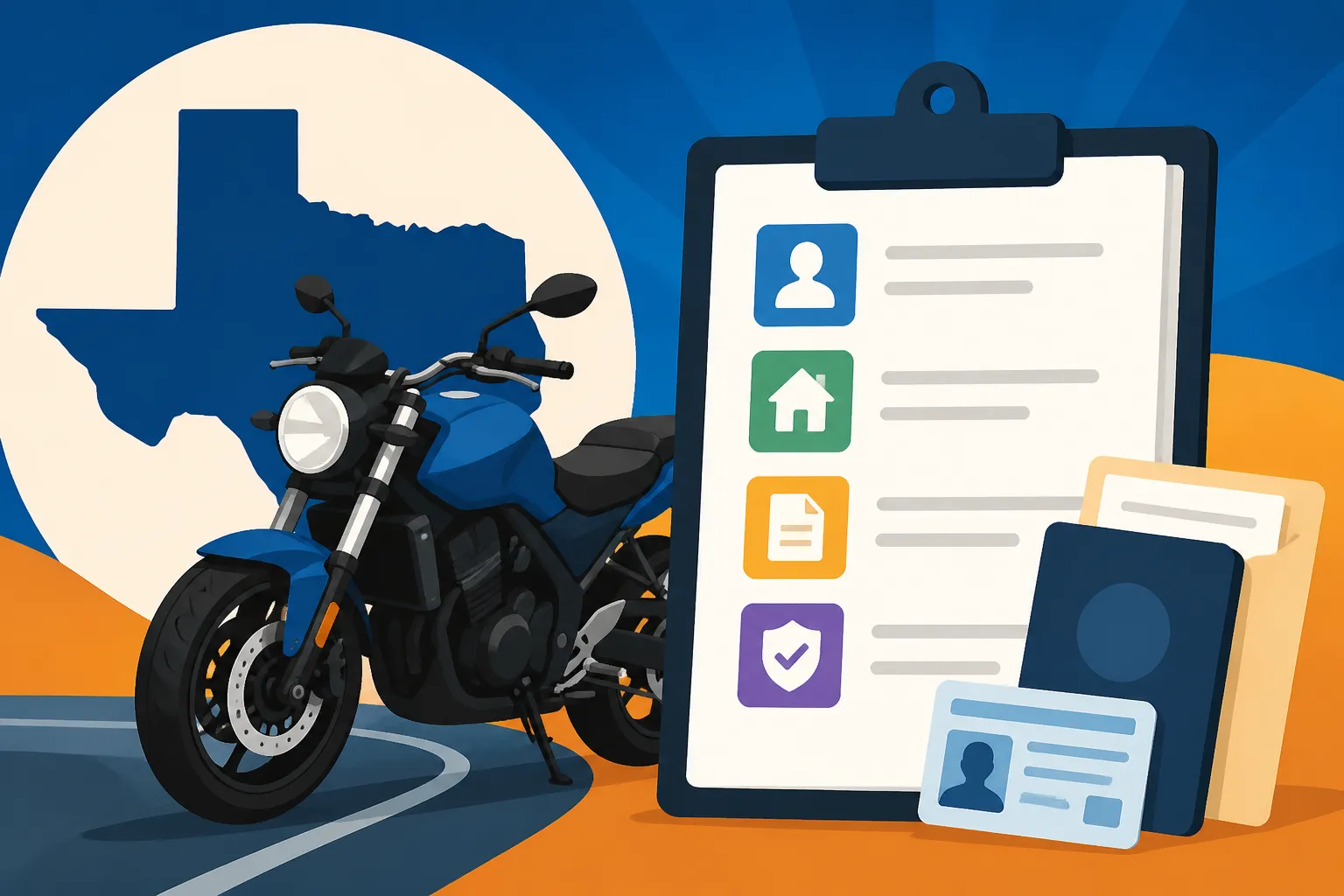
Getting a Texas motorcycle license can involve more than showing up with your current driver license. The right paperwork depends on whether you’re applying for your first Texas credential, adding a Class M, transferring from another state, or applying as a minor. Use this checklist to organize your documents before your DPS visit and spot the items that may need extra attention.
Start with the right application situation
Texas issues motorcycle driving privileges as a Class M license or endorsement. The documents you need depend on what you already hold and where it was issued. A first-time Texas applicant generally has more to prove than someone adding Class M to an existing Texas license.
Before gathering paperwork, identify which situation describes you:
- You already have a Texas driver license: You’re applying to add Class M to your existing credential. Bring your current license and the motorcycle-course or testing documents that apply to your case.
- You’re applying for your first Texas driver license: You’ll need the identity, lawful-presence, Social Security number and Texas-residency documents required for a Texas credential, along with motorcycle-specific paperwork.
- You have a motorcycle license or endorsement from another state: You may be able to transfer it, but the transfer requirements depend on your license status and circumstances. See Does an Out-of-State Motorcycle Endorsement Transfer to Texas? for the transfer-specific questions.
- You’re under 18: Expect extra requirements involving a parent or guardian, driver education, a motorcycle safety course and the kind of Texas credential you already hold.
- You’re applying for a standalone Class M: Check with the Texas Department of Public Safety (DPS) about the appropriate application process and whether your existing credential changes the documents you need.
A Class M application is still a driver-license transaction, so use a Texas DPS driver license office—not a county tax office. Texas DPS handles driver licenses; vehicle registration and title services are separate. If you’re unsure which office handles a service, Texas DPS or TxDMV: Where to Go for Your Driver’s License? explains the difference.
Rules and document acceptance can depend on your age, immigration status, current credential and whether DPS already has your records. Check the official DPS requirements for your situation before your appointment. The checklist below is a planning tool, not a guarantee that every item will be required in every case.
Core documents to prepare
These are the main document categories to consider for a Texas Class M application. Some may already be on file if you have an existing Texas credential. Bring the requested items in the original form DPS accepts, and avoid relying on a phone photo or an ordinary photocopy unless DPS specifically says it is acceptable.
| Document category | Who may need it | What to prepare |
|---|---|---|
| Current driver license or ID | Applicants with an existing credential | Bring your current Texas credential or, for a transfer, your out-of-state license |
| Identity and lawful presence | First-time Texas applicants and some other applicants | An acceptable identity and citizenship or lawful-presence document |
| Social Security number | Applicants whose number must be established or verified | The number and any supporting document DPS requests |
| Texas residency | Applicants establishing Texas residence | The required number of acceptable documents showing a Texas residential address |
| Motorcycle safety-course certificate | Applicants relying on a course to meet a requirement or qualify for a waiver | The completion certificate from a course accepted for Texas licensing |
| Parent or guardian documents | Applicants under 18 | Required consent, attendance and supporting documents |
| Name-change records | Applicants whose current name differs from supporting records | Official records linking the names |
| Test-vehicle documents | Applicants taking an on-road motorcycle test | Current registration and insurance evidence for the test motorcycle |
Identity and lawful-presence evidence
If you’re applying for your first Texas driver license or DPS needs to establish your identity or lawful presence, prepare the documents that match your status. Acceptable evidence may include a qualifying U.S. passport, birth certificate or immigration document, but not every document serves the same purpose. A document that proves identity may not, by itself, establish lawful presence.
Use the official DPS list to select the correct document or combination of documents. For more help sorting the categories, see Proving U.S. Citizenship or Lawful Presence for a Texas Driver License. Bring the physical original or certified copy when required; a scan, photocopy or picture may not be accepted in its place.
If your immigration status has changed, your current document may need to be checked against other records. Don’t assume that an expired visa stamp alone tells DPS whether you qualify. Bring relevant current status documents and confirm the requirements for your situation before traveling to the office.
Social Security number
DPS may verify your Social Security number electronically. If it can’t verify the number, or if your application requires supporting evidence, you may need to show an accepted document. The specific evidence DPS accepts can depend on the applicant and the transaction.
Make sure the information you provide matches your official records. A name or number mismatch can hold up an application even when you brought the other required documents. If you’re unsure what to bring, check the current DPS instructions rather than assuming your existing Texas license means no verification will be needed.
Texas residency evidence
A first-time Texas applicant may need to show documents establishing Texas residence. Residency documents generally need to show your name and residential address, and DPS may require more than one document. A mailing address by itself may not establish where you live.
Common document types used for residency evidence can include records from a financial institution, utility provider, school or government agency, but the current DPS list controls what qualifies and whether a particular item meets the rules. Review Acceptable Documents to Prove Texas Residency for a Driver License before choosing what to bring.
If you recently moved, use documents that reflect your present Texas residence, not an old address. If the address on a bill or account differs from your current home, bring other eligible evidence that clearly supports your Texas residential address.
Motorcycle-specific paperwork
The Class M part of the application has its own evidence requirements. These usually relate to your motorcycle safety course, the tests you must take or a motorcycle credential you already hold.
Motorcycle safety-course completion certificate
If you completed a motorcycle safety course, bring the completion certificate issued for that course. DPS needs to be able to determine that it is the type of course accepted for Texas licensing and that the certificate meets the applicable requirements.
A course certificate may allow an applicant to meet a training requirement or qualify for a waiver of a motorcycle knowledge or skills test. What it waives can depend on the applicant and current rules. Don’t assume that a course certificate replaces every test or every other licensing document. Read Texas Motorcycle Safety Courses: Are Written Tests Waived? and Texas Motorcycle Skills Test Waiver: When Course Certificates Count? for the distinction between the course, the written test and the riding test.
Before your appointment, check:
- That the certificate identifies you correctly.
- That it is complete and legible.
- That the course is accepted for Texas motorcycle licensing.
- Whether the certificate must be presented within a specific validity period.
- Whether you need a paper certificate or DPS can verify completion another way.
If the name on the certificate differs from your driver-license records, bring official name-change documentation that connects the two names. A course provider’s record or email may help you resolve a missing certificate, but don’t assume it will replace the document DPS requires.
Existing motorcycle license or endorsement
If you already hold a motorcycle license or endorsement from another state, bring the actual credential. If you have a separate motorcycle credential as well as a regular driver license, bring both. DPS may need to review the class, restrictions, status and expiration information before deciding how the transfer applies.
A transfer is not always identical to adding Class M to a Texas license. Whether tests or training are required can depend on the details of your current license and your eligibility. For a transfer, use Does an Out-of-State Motorcycle Endorsement Transfer to Texas? and confirm the documents with DPS before your visit.
If your out-of-state credential is expired, suspended, restricted or unavailable, explain that when checking your requirements. Bring any official record you have that clarifies your license status. A temporary paper credential may not contain enough information for DPS to determine whether the motorcycle privilege can transfer.
Current Texas driver license
If you already have a Texas driver license, bring it even if you know the number. It helps DPS connect the Class M application to your existing record. If the card is lost, don’t delay preparation until you find it; check whether you need a replacement or another form of identification before applying.
If your Texas license is suspended or you’re unsure whether you’re eligible for a new service, check your record first. Checking Your Texas Driver License Eligibility Online covers the eligibility portal and what it can help you confirm.
Application and appointment details
Use the current application instructions for the service you’re requesting. The form and application process can vary with the type of credential and applicant. Don’t rely on a form downloaded or saved for a previous transaction without checking whether DPS still accepts it.
Bring your appointment confirmation or other appointment details if you have them, and make sure the appointment is for the service you need. An appointment for a standard driver-license service may not be the right selection for adding Class M or completing a motorcycle test. For general preparation, What Documents to Bring to a Texas DPS Driver License Appointment and Texas Driver License Checklist: What to Take to Your DPS Visit can help you organize the broader DPS paperwork.
Extra documents for first-time Texas applicants
If you don’t already have a Texas driver license or ID, treat the motorcycle application as part of a broader driver-license transaction. You may have to establish your eligibility for a Texas credential before DPS can issue the Class M privilege.
Prepare the following categories if they apply:
- Proof of identity and lawful presence. Choose documents from the current DPS list for your specific status.
- Social Security number information. Provide the number and supporting evidence if DPS requires it.
- Texas residency evidence. Gather the number and types of acceptable documents required for your application.
- Name-change records. Bring official records if your current legal name differs from the name on identity, residency, course or license documents.
- Motorcycle-course records. Bring your course certificate if you completed an approved course.
- Any existing out-of-state license or ID. Bring it even if you’re applying for a Texas credential for the first time.
For a detailed review of first-visit documents, use What Documents to Bring to a Texas DPS Driver License Appointment. If you’re moving to Texas and have a current license from another state, the documents and tests may differ from those for someone who has never been licensed. DPS’s requirements for a new Texas resident should guide your preparation.
Name differences across records
Check the names on your license, birth or immigration documents, Social Security record, course certificate and residency evidence. Small differences can create a verification delay. If you changed your name because of marriage, divorce or a court order, bring the official record that supports the change.
A marriage certificate or court order may establish a link between names, but DPS decides which records are acceptable for the transaction. If a document uses a former name and another uses your current name, bring the chain of official records that connects them. For more on this issue, see Documents Needed for a Texas DPS Driver License Name Change.
Immigration documents and pending status changes
Applicants who are not U.S. citizens may need to provide immigration and lawful-presence documentation. Bring current documents related to your status and any official receipt or notice that may be relevant to a pending extension or change. The specific documents DPS needs depend on your case, so verify the requirements directly with DPS before your appointment.
Don’t rely on a course certificate or an existing out-of-state motorcycle endorsement to resolve an identity or lawful-presence requirement. Those documents serve different purposes. If you’re uncertain which records to use, review Driver License Options for Foreign Citizens and Visitors in Texas and confirm your individual requirements with DPS.
Extra requirements for applicants under 18
A minor applying for motorcycle driving privileges should plan for additional documents and adult involvement. The exact requirements depend on age, current license status and completion of driver education and motorcycle training. Check the current DPS instructions for the minor’s specific application rather than using an adult checklist.
Parent or guardian consent and attendance
A parent or legal guardian may need to accompany the applicant or provide consent. The adult may need to show identification and establish their authority to give consent. If a guardian rather than a parent is involved, bring the applicable court or legal documents.
Confirm who must attend before making the appointment. If the required adult cannot attend, ask DPS whether an alternate consent process is allowed and what documents it requires. Don’t assume that a signed note from a parent will be enough.
Driver education and existing credential
A teen may need to satisfy driver-education requirements and hold an eligible Texas learner license or driver license before applying for Class M. The motorcycle privilege may not be available as a stand-alone substitute for the required underlying credential.
Bring any applicable driver-education completion records, learner license or Texas driver license, and school-related documents required for the teen’s situation. If the teen is applying for a first learner license or driver license at the same time, the appointment and paperwork may involve requirements beyond the motorcycle application. See Texas Teen Driver License: Required Documents for DPS or Guide to Getting a Texas Learner or Provisional License for related teen licensing steps.
Motorcycle course and test expectations
A minor may have to complete an approved motorcycle safety course, and a course certificate may affect which tests are required. Bring the certificate and check whether the teen must also complete a knowledge or skills test.
The course certificate does not eliminate the need for parent consent, identity records, residency evidence or other driver-license requirements. Keep these categories separate when assembling the packet: course completion demonstrates motorcycle training; it does not establish the applicant’s identity, age or Texas residence.
If you must take a motorcycle skills test
Not every applicant takes the motorcycle skills test. A qualifying course certificate or transferable motorcycle credential may affect the testing requirement. If DPS tells you that a skills test is required, the motorcycle itself and its paperwork become part of your preparation.
Documents for the motorcycle
Bring current evidence that the test motorcycle is registered and insured as required. The vehicle used for a test generally needs to meet the testing rules, and the examiner may check that it is safe and suitable before the test begins. Confirm the current requirements with DPS, especially if the motorcycle is borrowed or belongs to someone else.
The person providing the motorcycle should be able to show that it may be legally operated and that required insurance coverage applies. Bring the registration and insurance evidence in a form the examiner can review. If the motorcycle is not registered in your name, ask in advance whether additional proof is needed.
A vehicle document problem can prevent a test from going ahead even if your license application paperwork is complete. Treat test-vehicle documents as a separate checklist from your personal identity documents.
Equipment and readiness
Protective equipment is not a document, but it may be required for a motorcycle test or course. Check the current DPS testing instructions for helmet, eye protection and other equipment rules. Make sure the motorcycle has the required safety equipment and that you can operate it legally to the testing location.
If you need to practice before the test, use a properly licensed and insured motorcycle and follow learner restrictions that apply to you. Don’t ride to an appointment unless your current license or permit allows you to do so. If you need to transport the motorcycle, arrange that separately.
For more on the skills-test paperwork, see Documents to Bring to Your Motorcycle Skills Test. That checklist can help you keep the motorcycle’s registration and insurance evidence distinct from the documents required for the license itself.
Final pre-appointment checklist
Use this short review the day before your DPS visit. Remove items that don’t apply, but don’t leave out a category until you have confirmed it is unnecessary.
Personal documents
- [ ] Current Texas driver license or ID, if you have one
- [ ] Out-of-state driver license and motorcycle credential, if applicable
- [ ] Acceptable identity and lawful-presence documents, if required
- [ ] Social Security number and supporting evidence, if required
- [ ] Texas residency documents, if required
- [ ] Official name-change documents, if your records use different names
Motorcycle documents
- [ ] Motorcycle safety-course completion certificate, if applicable
- [ ] Current motorcycle credential or endorsement from another state, if applicable
- [ ] Appointment details and the correct service selection
- [ ] Motorcycle registration and insurance evidence, if taking a skills test
- [ ] Any additional test records DPS instructed you to bring
Minor applicant documents
- [ ] Parent or guardian attendance and consent documents
- [ ] Parent or guardian identification
- [ ] Court or legal guardianship papers, if applicable
- [ ] Driver-education or school documents required for the teen’s application
- [ ] Current Texas learner license or driver license, if applicable
Place originals and certified documents together, but keep test-vehicle paperwork in a separate folder. If a document is difficult to replace, do not hand it over without understanding whether DPS needs to inspect it or retain it. Bring a backup document from an acceptable category where practical, but don’t assume that extra papers will compensate for a missing required record.
Before leaving, check the current official DPS instructions for your exact application type, appointment category, testing status and document rules. If anything is unclear—especially a transfer, a minor’s application, a status document or a name discrepancy—contact DPS or use its official service information to confirm what to bring. Find the nearest driver license office and its current hours with the official agency’s office locator.
Frequently Asked Questions
Do I need a motorcycle safety-course certificate to get a Texas Class M?
Requirements vary by age and application circumstances. An approved course certificate may be required or may affect whether you need to take a motorcycle knowledge or skills test. Confirm the rule for your situation with DPS and bring the certificate if you completed a course.
Can I use my out-of-state motorcycle endorsement in Texas?
A current out-of-state motorcycle credential may be transferable, but the result depends on the credential and your circumstances. Bring it with your driver license and check the Texas transfer requirements before your appointment.
What should I bring if I already have a Texas driver license?
Bring your current Texas license, the required Class M application or appointment information, and any motorcycle-course or testing documents that apply. DPS may need additional records if your identity, status or other information cannot be verified.
What if my motorcycle skills test is waived?
You may not need test-vehicle documents if you are not taking a skills test, but you still need the personal and motorcycle-specific documents required for your application. Confirm that DPS has accepted the basis for the waiver before assuming the test is not required.
Disclaimer
This article is for general informational purposes only and does not constitute professional advice. Laws, prices and regulations vary by location and change over time. Consult a qualified professional for guidance on your specific situation. Texas Driver Guide is not a government agency and is not affiliated with any state motor vehicle department.